4 min read

Three charts to explain the Medicare Part D market in CY2027

Three charts to explain the Medicare Part D market in CY2027
12:55


On Tuesday, July 28, 2026, CMS released a memo outlining much of what we can expect for Medicare Part D in Contract Year 2027. Three key figures come out of that memo: the National Average Monthly Bid, the National Beneficiary Base Premium, and the De Minimis Amount. Each figure can give health insurance agents some directional signals about what the market will look like when plan details are released.

Spoiler: They likely won’t get better, and commissions likely won’t return. 

The national average monthly bid amount represents what Part D plans bid to provide basic prescription drug benefits. This foundational metric drives all other Part D pricing calculations.
Year Bid Amount Year-over-Year Change Market Impact
2023 $34.71 Pre-IRA Baseline
2024 $64.28 +85.2% Initial IRA Impact
2025 $179.45 +179.2% Major Restructuring
2026 $239.27 +33.3% Continued Adjustment
2027 $296.05 +23.7% Demo Concludes
Key Insight: The 753% increase from 2023 to 2027 reflects plans taking on 60% of catastrophic coverage costs (up from 20%) under the Inflation Reduction Act. Year-over-year growth has slowed for a second straight year, from 179.2% in 2025 to 33.3% in 2026 to 23.7% in 2027, as the Part D Premium Stabilization Demonstration concludes and plans return to bidding under traditional market conditions.
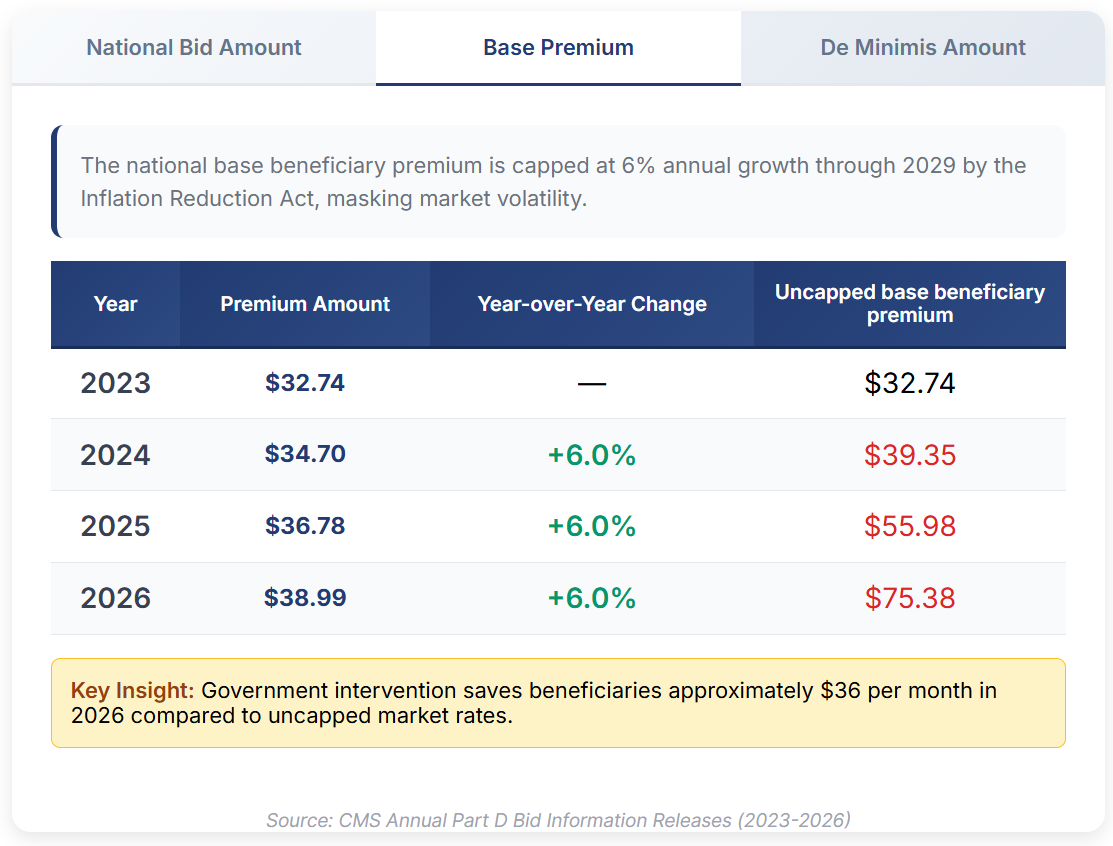
The base beneficiary premium is capped at 6% annual growth through 2029 by the Inflation Reduction Act, creating government subsidies that mask true market volatility.
Year Premium Amount Year-over-Year Change Without Cap Would Be
2023 $32.74 $32.74
2024 $34.70 +6.0% $39.35
2025 $36.78 +6.0% $55.98
2026 $38.99 +6.0% $75.38
2027 $41.33 +6.0% $94.06
Key Insight: Government intervention saves beneficiaries approximately $53 per month in 2027 compared to uncapped market rates ($94.06 uncapped vs. $41.33 capped) — the widest gap since the cap took effect in 2024.
The de minimis amount represents the small premium that Part D plans can voluntarily waive for low-income subsidy eligible individuals above the benchmark amount.
Year De Minimis Amount Change Plan Participation
2023 $2.00 No Change Voluntary
2024 $2.00 No Change Voluntary
2025 $2.00 No Change Voluntary
2026 $2.00 No Change Voluntary
2027 $2.00 No Change Voluntary
Key Insight: This amount has held at $2.00 for five straight years (2023-2027), signaling plan commitment to serving vulnerable populations despite rising costs elsewhere in the system.
Source: CMS Annual Part D Bid Information Releases (2023-2027)

The National Average Monthly Bid Amount and what it tells us about CY2027

The National Average Monthly Bid Amount (NAMBA) represents an average of what every Part D plan bids to provide the standard prescription drug benefit to its service area. This figure undergirds most other Part D pricing calculations, and doesn’t take into account subsidies, risk adjustments, or any individual plan’s pricing strategy.

A quick look at the table above will tell you this figure ballooned since the Inflation Reduction Act of 2022. The NAMBA has increased 753% between 2023 ($34.71) and 2027 ($296.05).

In plain English, plans think it costs nearly eight times as much to provide the same Basic benefit they were providing in 2023.

Now, the news isn’t all doom and gloom. The rate of growth in this measure has slowed from its peak in 2025 (179.2%). The CY2027 increase is the second straight year of slowed growth, weighing in at 23.7%.

The trend tells us the market is now adjusting to the Part D redesign, which forced carriers to take on 60% of the cost of catastrophic coverage.

The Part D Premium Stabilization Demonstration is ending

Also baked into the memo: CMS is ending the Part D Premium Stabilization Demonstration. The program smoothed the Part D Redesign adjustment by offering a $10 base beneficiary premium reduction for plans volunteering to cap their year-over-year premium increases.

In effect, carriers were incentivized to keep their premiums lower.

In CMS’s own words, plan sponsors “had sufficient experience under the redesigned Part D benefit” to bid without that support. So, they’re pulling it.

So the training wheels are coming off. Part D bids and prices will more closely reflect a real, unsubsidized market. And, whatever volatility the demonstration may have masked may come into clearer view.

The National Base Beneficiary Premium is capped at $41.33 in 2027

The National Base Beneficiary Premium gives us a baseline for what the average consumer would pay for the Basic Part D benefit. It does not account for pricing for enhanced benefits, carriers’ national and regional pricing strategies,  or Income Related Monthly Adjustment Amounts. It does, however, impact the calculation of Part D Late Enrollment Penalties.

The Inflation Reduction Act of 2022 caps the annual growth of this measure at 6% through 2029, regardless of plan bids. And, the figure hit that mark again, increasing from $38.99 in 2026 to $41.33 in 2027.

CMS is also obligated to report the premium without that cap: $94.06 for 2027, compared with the actual $41.33. That’s a $52.73 gap, which is the widest it’s been since the cap took effect in 2024.

The size of that gap tells us it's protecting consumers from some price increases. But serious questions remain about what happens when the 6% cap sunsets after 2029.

The de minimis amount remains the same

The de minimis amount —  the small premium PDPs and MA-PDs can voluntarily waive for LIS-eligible members — has been set at $2.00 every year since 2023. Not a headline, but something to keep in mind for LIS conversations: this piece of the program hasn’t budged while everything around it has.

What can Medicare agents expect as a result of this announcement?

Since 2023, the cost to carriers who provide drug coverage has risen 753%. The baseline premium has only risen 24%.

That does not bode well for carrier finances. We’ll likely see plans take advantage of the new maximum deductible ($700) and out-of-pocket maximum ($2,400) in 2027. Tier III copays may move into the rearview mirror, as carriers try to make up some dollars by switching to coinsurance models instead.

It’s also unlikely standalone Part D plans will once again become commissionable.

What can a Medicare agent tell their clients at this point?

For a variety of reasons, there aren’t many specifics you can share at the moment.

This memo only sets the bid amount and base beneficiary premium. It does not set what any individual plan will charge. CMS also gave plans through August 6, 2026 to reallocate their bids and rebates after this release – and given the heft here, it’s likely plans will resubmit.

In short, the actual 2027 premiums, deductibles, and formularies your clients will see on their ANOC just don’t exist yet.

However, should you get questions from clients about what to expect for the year ahead, you now have an even-keeled read on the market before the actual numbers hit mailboxes.

3 charts to explain the Medicare Part D market in 2026

6 min read

3 charts to explain the Medicare Part D market in 2026

National Bid Amount Base Premium De Minimis Amount The national average monthly bid amount represents what Part D plans bid to provide...

Read More
CMS would relax marketing rules for agents/brokers in CY2027 Medicare proposed rule

4 min read

CMS would relax marketing rules for agents/brokers in CY2027 Medicare proposed rule

Just after markets closed on November 25, the Centers for Medicare and Medicaid Services (CMS) released its proposed rule for the Medicare market for...

Read More
CMS releases CY2027 commissions for Medicare Advantage

3 min read

CMS releases CY2027 commissions for Medicare Advantage

On June 1, the Centers for Medicare and Medicaid Services released updated commission figures for Contract Year 2027. The figures represent the...

Read More